
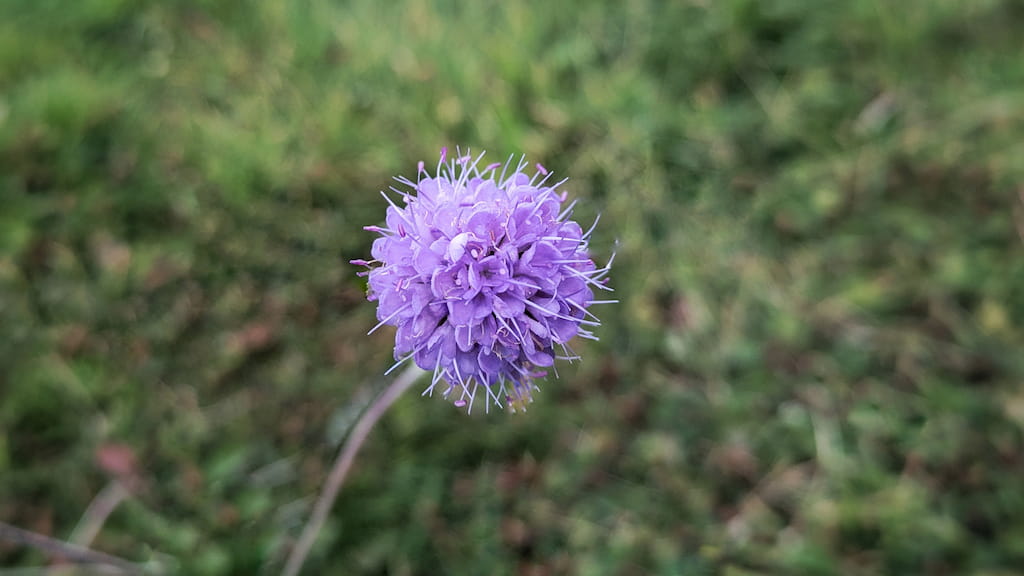
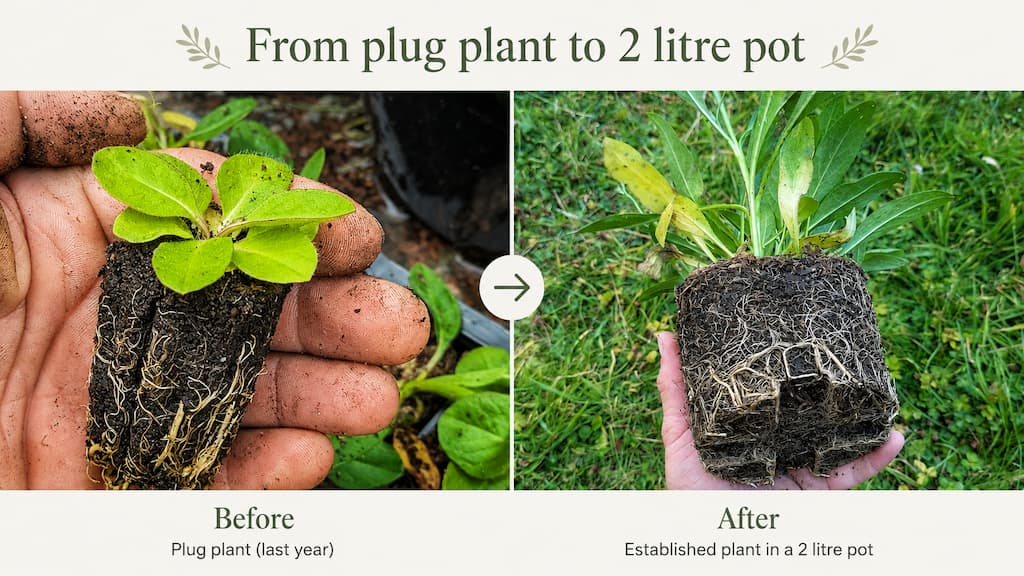
Last year, I began growing Devil’s-bit Scabious (Succisa pratensis) after purchasing 25 small plug plants from Cumbria Wildflowers. They arrived with only a modest amount of growth above the compost, but represented the beginning of a much bigger ambition: to propagate this valuable native wildflower and establish it on suitable land grazed by our Highland cattle.
Some of the original plants were planted out on land we were managing at the time. Others remained at home, where I potted them on and continued caring for them.
Those retained plants have now developed into substantial specimens in two-litre pots, and several are beginning to produce their first purple flowers. It is an encouraging stage in the project—but flowering is not the end goal.
By maintaining some Devil’s-bit Scabious as a living propagation stock, we hope to produce new plants year after year and establish them on suitable sites where our cattle are helping to manage land for nature.
What is Devil’s-bit Scabious?
Devil’s-bit Scabious is a native perennial wildflower with rounded, purple-blue flower heads held above a low rosette of leaves. Despite its common name, it is not one of the true scabious plants belonging to the genus Scabiosa. Its scientific name is Succisa pratensis.
It is a clump-forming perennial, meaning that an established plant can survive for many years and gradually increase in size. Its flowers usually appear in late summer and can continue into autumn, providing nectar and pollen when fewer wild plants remain in bloom.
The distinctive pincushion-like flower heads are visited by bees, hoverflies, moths and butterflies, making Devil’s-bit Scabious valuable in wildlife gardens as well as suitable grassland habitats.
It is particularly associated with damp grasslands, heaths, moorland, fens and other relatively unimproved habitats. Although it favours moisture-retentive ground, it does not require permanently waterlogged soil. It can grow in moist but reasonably well-drained conditions in full sun or partial shade.
Why Devil’s-bit Scabious matters to marsh fritillaries
Devil’s-bit Scabious has an especially important relationship with one of Britain’s most striking and threatened butterflies: the marsh fritillary.
It is the principal food plant of marsh fritillary caterpillars. Female butterflies lay batches of eggs on suitable Devil’s-bit Scabious plants. After hatching, the young caterpillars live communally and spin conspicuous silken webs around the vegetation on which they feed.
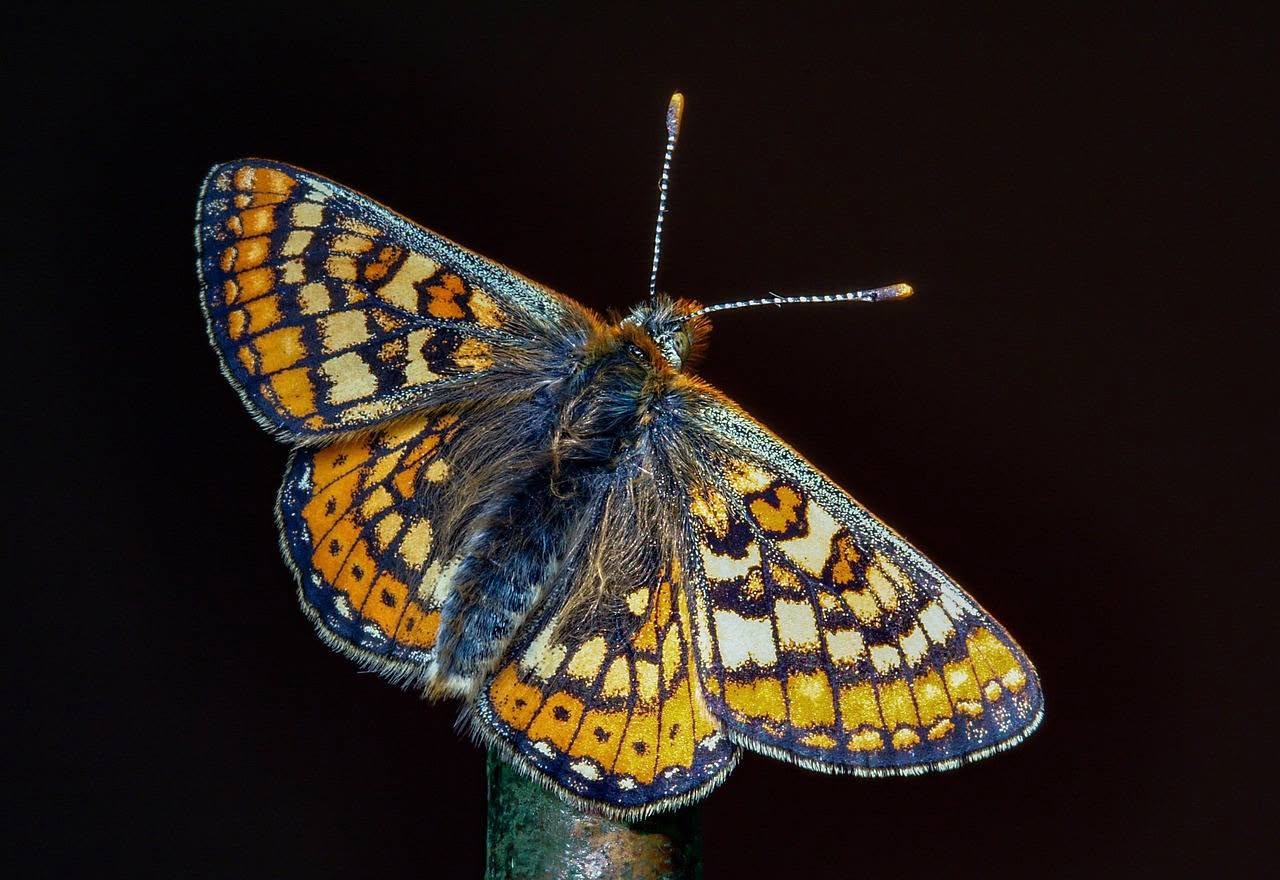
This means that the presence of a few flowers alone is not enough to support the butterfly. Marsh fritillaries require healthy concentrations of Devil’s-bit Scabious growing within vegetation of the right height and structure. The surrounding habitat must also provide a suitable microclimate for egg-laying, caterpillar development and adult butterflies.
A few isolated plants in unsuitable surroundings are unlikely to support a marsh fritillary colony. Expanding the abundance and distribution of Devil’s-bit Scabious can, however, contribute to the wider network of habitat the butterfly needs.
That wider network is particularly important because marsh fritillary populations naturally fluctuate. Individual colonies can increase rapidly and then decline. Connected groups of suitable habitat give dispersing butterflies opportunities to establish new colonies or reinforce existing ones.
You can read more about the butterfly’s recovery in our earlier article, Bringing Back the Marsh Fritillary in Cumbria.
From small plugs to flowering plants
When the original plug plants arrived, I potted them up rather than planting every one immediately. This allowed the young plants to develop stronger root systems while giving me an opportunity to observe how they grew.
They have since been moved into two-litre pots and are becoming considerably more substantial. Keeping part of the original group at home has also created a valuable reserve from which more Devil’s-bit Scabious can be propagated.
The first flowers are therefore important for more than their appearance. If they are successfully pollinated, they should produce seed that can be collected and used to raise a new generation of plants.
Growing from seed also provides something that division cannot. Plants created by splitting an established clump are genetically identical to their parent, whereas seedlings are produced through sexual reproduction and may contain new combinations of the genetic variation present among the parent plants.
I intend to collect seed from as many of the flowering plants as possible rather than relying heavily on the output of a single specimen.
Propagating Devil’s-bit Scabious from seed
Growing Devil’s-bit Scabious from seed should allow us to produce larger numbers of plants from the stock we already have.
Once the flower heads mature, dry and begin to turn brown, the seed can be collected before it is naturally dispersed. It can then be cleaned and sown into pots, trays or modules.
As with many native perennial wildflowers, autumn sowing can be beneficial because the seed experiences natural winter temperatures outdoors. The seed should be sown on or close to the surface and covered only lightly, rather than being buried deeply.
Germination may not occur uniformly. Some seeds may emerge readily, while others may take longer. Raising at least some of the seedlings at home will allow me to protect them during their vulnerable early stages, monitor their development and grow them into robust plants before introducing them to a grazing site.
Direct sowing may also have a place in the project. However, scattering all the available seed into established grassland would risk losing much of it through competition, unsuitable microsites, grazing, trampling or poor contact between the seed and the soil.
By retaining some seed for controlled propagation, we can produce established plants while also carrying out smaller direct-sowing trials in carefully selected and prepared areas.
Propagating established plants by division
Seed is not the only way to increase our stock of Devil’s-bit Scabious.
As a clump-forming perennial, an established plant can develop several crowns or growing points as it becomes larger. A sufficiently vigorous plant may then be carefully divided into smaller rooted sections. Each division can be potted separately and allowed to recover before being planted out.
Division can produce usable plants more quickly than starting entirely from seed. Every division is, however, genetically identical to the plant from which it came.
We therefore intend to use both propagation methods:
- raising plants from seed to produce a varied new generation;
- carefully dividing healthy, established plants to increase numbers more quickly.
Using both approaches should allow our propagation stock to expand without becoming dependent on repeated divisions from only one or two plants.
Building a renewable stock for future grazing sites
Keeping some Devil’s-bit Scabious at home is an important part of our longer-term approach.
Rather than planting every specimen in one location, we can maintain a small living stock that continues to flower, produce seed and generate new plants. These plants can gradually be introduced to suitable areas of land managed or grazed by our Highland cattle, wherever the habitat and land-management arrangements allow.
Not every site will be appropriate. Devil’s-bit Scabious needs suitable soil moisture, manageable competition from surrounding vegetation and enough light. Newly established plants may also require protection from heavy grazing or trampling until their root systems are strong enough.
The aim is not to plant it indiscriminately wherever the cattle happen to be. Instead, we want to identify promising areas and establish concentrated patches where the plants have a realistic chance of surviving, spreading and contributing to the habitat.
Maintaining a propagation stock makes the work repeatable. Seed and plants produced during one year can create additional parent plants, which can then provide more propagation material in future years.
Highland cattle and wildflower habitat
The relationship between grazing and Devil’s-bit Scabious requires balance.
Without enough grazing or cutting, vigorous grasses, rushes, scrub and accumulated dead vegetation can overwhelm smaller wildflowers. Too much grazing, on the other hand, can repeatedly remove flowers and foliage, damage plants through trampling and prevent successful seed production.
Appropriately managed cattle grazing can help create a varied vegetation structure. Cattle do not graze every plant to the same height, and their movement can produce a mixture of shorter turf, taller vegetation and occasional areas of disturbed ground.
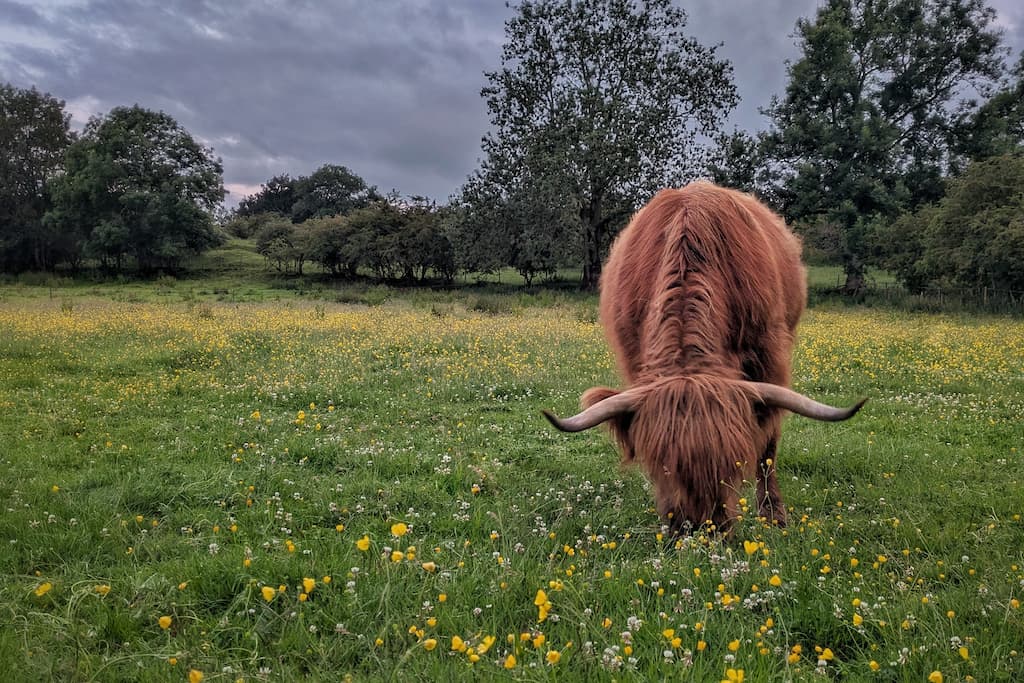
The timing and intensity of grazing are crucial. Where appropriate, we can use rotational or strip grazing to concentrate grazing for short periods before moving the cattle on, allowing vegetation time to recover and helping prevent repeated grazing of the same plants. Areas containing newly established plants may need temporary protection, while enough flowering stems must be allowed to survive so that they can produce seed.
This is not simply a matter of placing cattle in a field and expecting biodiversity to increase automatically. Conservation grazing requires observation and adjustment in response to the vegetation, soil conditions, weather and ecological objectives of each site.
More than a plant for one butterfly
The marsh fritillary gives Devil’s-bit Scabious particular conservation importance, but it is not the only species that benefits.
Its late flowers provide food for numerous insects, including common pollinators in gardens and grasslands far beyond the current range of the marsh fritillary.
This makes growing the plant worthwhile even on sites that are unlikely to be colonised by marsh fritillaries in the immediate future. Every healthy patch can contribute nectar, pollen and botanical diversity while helping preserve a native wildflower that has disappeared from many agriculturally improved grasslands.
In locations within reach of existing marsh fritillary populations, larger and better-connected patches may have additional value as potential breeding habitat or stepping stones across the landscape.
The next stage of our Devil’s-bit Scabious project
The immediate task is to allow the current plants to finish flowering and produce mature seed.
I will then collect seed from across the group and retain a portion for controlled propagation at home. As the plants continue developing into larger clumps, I will also assess which are sufficiently vigorous to divide.
Over time, our aim is to build a renewable supply of Devil’s-bit Scabious that can be used on suitable conservation-grazing sites rather than depending on a single planting effort.
The plants now flowering in their two-litre pots began as tiny plugs. Their progress is a useful reminder that nature recovery often starts on a modest scale: a handful of plants, a carefully managed patch of ground and a willingness to keep multiplying what works.
We may not see marsh fritillaries appearing immediately wherever Devil’s-bit Scabious is planted. Successful species recovery requires suitable habitat across a much broader landscape. Increasing the abundance of the butterfly’s principal food plant is, however, one practical contribution we can make.
By continuing to propagate Devil’s-bit Scabious and combining it with thoughtful Highland cattle grazing, we hope to establish more patches where this beautiful native wildflower—and the wildlife that depends upon it—can flourish.