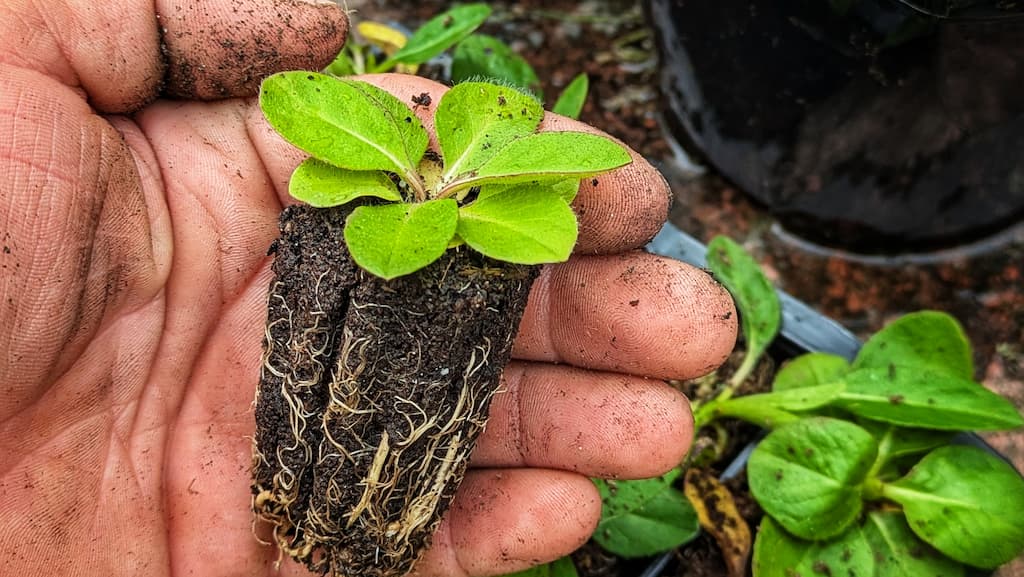
This week, I received 25 Devil’s-bit Scabious (Succisa pratensis) plug plants from Cumbria Wildflowers. These small, hardy wildflowers hold the key to one of the most hopeful and beautiful rewilding stories in northern England: the return of the marsh fritillary butterfly (Euphydryas aurinia).
I’ve potted the plugs up to grow them on with the aim of planting them across the land that Jenni and I manage in the Eden Valley, where we practice regenerative grazing with Highland cattle. My long-term goal is to establish a healthy, self-sustaining population of Devil’s-bit Scabious and, in time, help create the conditions needed to support the natural recolonisation of the marsh fritillary butterfly.
Why Devil’s-bit Scabious Matters
Devil’s-bit Scabious is a native wildflower known for its late-summer purple blooms. It’s not only a magnet for pollinators, but a crucial food plant of marsh fritillary caterpillars. Without it, the butterfly cannot survive in Cumbria.
The plant thrives in damp meadows, fens, and wet pastureland — habitats that once blanketed much of Cumbria but have declined drastically due to drainage, overgrazing, and changes in land use. As these habitats vanished, so too did the marsh fritillary.
This humble wildflower is now seen as a key species in efforts to restore the butterfly’s population. By planting Devil’s-bit Scabious, land managers can help recreate the conditions needed for the butterfly to return.
The Decline and Recovery of the Marsh Fritillary in Cumbria
The marsh fritillary butterfly was once widespread in Cumbria but was declared extinct in the county in 2004. A reintroduction effort began in 2007, spearheaded by local ecologists and supported by organisations like Cumbria Wildlife Trust, Natural England, and the RSPB.
Encouragingly, recent years have brought signs of hope.
In Swindale Valley, near Shap, the number of larval webs (the communal silk nests spun by marsh fritillary caterpillars) increased from 23 in 2023 to 101 in 2024. Each web can shelter dozens — even hundreds — of caterpillars, suggesting that the population is finally rebounding.
This success is thanks to sympathetic land management, careful grazing, and a renewed focus on planting and protecting Devil’s-bit Scabious across the landscape.
Ennerdale: A Rewilding Success Story
One of the most inspiring examples of marsh fritillary recovery is unfolding at the Wild Ennerdale project in western Cumbria. As part of this long-running rewilding initiative, marsh fritillaries were successfully reintroduced to the valley. The butterflies have now established themselves and are thriving — a testament to the power of landscape-scale habitat restoration.
The Ennerdale project shows that with the right habitat and conditions, the marsh fritillary can make a comeback. Ultimately, however, reintroductions only succeed if there’s a wider network of habitat patches — places for butterflies to feed, breed, and spread naturally.
That’s where farmers and other land managers across Cumbria could play a vital role.
Creating a Stepping Stone for Marsh Fritillaries
Inspired by the work of Cumbria Connect, I’m aiming to turn the land that Jenni and I manage into a stepping stone for the marsh fritillary. Their vision is simple but powerful: reconnect fragmented patches of suitable habitat across Cumbria. By doing so, the marsh fritillaries can move and recolonise naturally.
It’s a strategy based on landscape connectivity, and Devil’s-bit Scabious is the glue that holds it together.
As the butterfly is known for its boom-and-bust population cycles, corridors of suitable habitat increases the species’ resilience. When one population crashes, nearby colonies can repopulate the area. But not only that, the connection of core areas of habitat allows crucial gene flow to occur.
By planting Devil’s-bit Scabious plugs now, and propagating more over time, I hope to contribute to this growing network of habitat. It may take years, but species recovery doesn’t occur overnight: it’s a long-term investment in biodiversity.
Highland Cattle and Conservation Grazing
What’s especially encouraging is how well this fits with our existing land management. We keep Highland cattle, a traditional native breed perfectly suited to Cumbria’s wet climate and rough pasture. By applying the right amount of grazing pressure, by controlling livestock density and through rotational grazing, coarse vegetation is suppressed, opening up space for wildflowers like Devil’s-bit Scabious to flourish.
Propagation Plans
Right now, I’m growing the plug plants on in pots, letting them establish strong roots. Once they’re ready, I’ll plant them out into damp, lightly grazed areas — hollows, field edges, and places with lower footfall. These plants can be slow to spread on their own, so I’ll also collect seed each year to propagate more.
Over time, my goal is to create multiple patches of Devil’s-bit Scabious across the land. Hopefully this will, one day, catch the attention of adventurous marsh fritillaries looking for new ground.